
Payment completes the buying decision.
Order, amount, payment, confirmation, and settlement should remain one traceable movement.
What happens, and what does it mean?
The customer has decided. The remaining work is to complete that decision clearly.
How does the capability work inside operations?
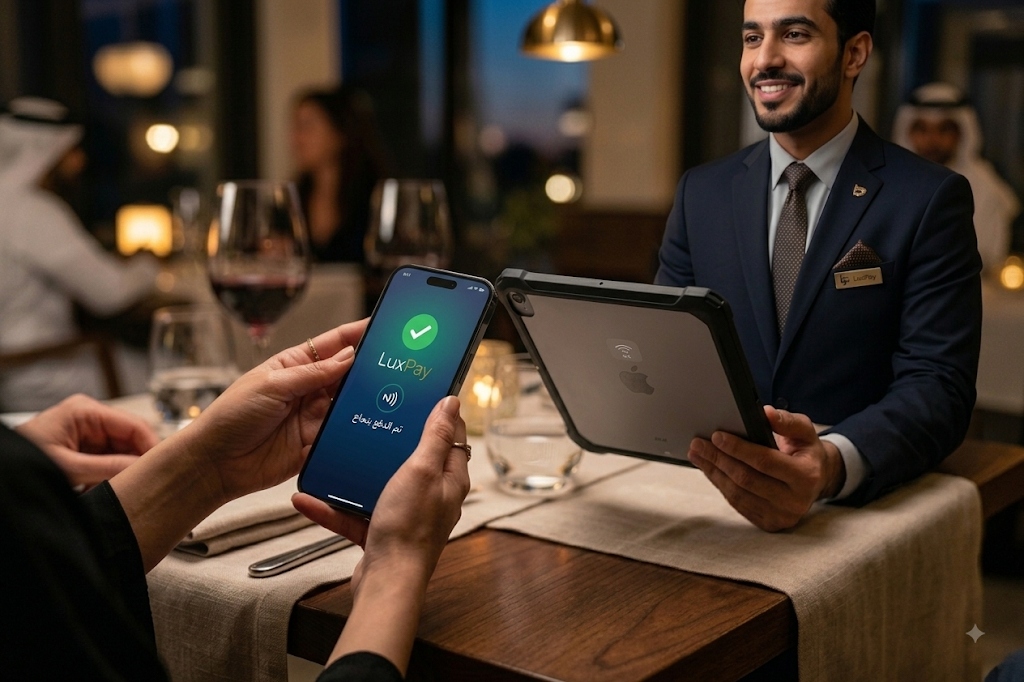
LuxPay connects payment request and provider status to the order within enabled market and integration.
LuxPay
What it adds
One reference brings together order, amount, currency, and branch from initiation.
Payment methods appear according to market, provider, and merchant agreement rather than as one universal list.
The order is not treated as paid from the customer screen alone; the enabled integration must return a trusted result.
The operation reference remains present through retries to reduce duplicate-payment risk within the enabled path.
Settlement, refund, and later states appear only to the extent supported by the provider and permissions.
The journey can begin from POS, Nexora, Customer Display, or Plus and NFC when the channel, device, and provider are supported.
How it appears in operations
How does this appear in daily work?
A guest reviews the basket on Customer Display and opens a supported payment QR.
A Nexora order carries branch, fulfilment, and payment state into execution.
Plus opens an NFC path on compatible hardware and provider integration.
A local provider returns a result tied to the order instead of requiring manual matching.
Available in
Compatible plans
- FoodTech Free with provider activation
- Growth Flex
- Pro Branch
- Scale
- Enterprise
Connects with
Products it connects with
- FoodTech POS
- FoodTech Nexora
- FoodTech Online
- Accounting
FAQ
What you need to know
Is LuxPay the payment provider itself?
LuxPay is a platform that connects an order to a payment path and manages transaction reference and state across supported providers. Actual provider availability depends on market, merchant account, agreement, and activation.
Does every merchant see the same payment methods?
No. LuxPay presents methods proven for the region, device, merchant account, and enabled integration.
When is an order considered paid?
When a trusted provider result returns through the enabled path and is tied to the correct transaction reference. A customer-facing success screen alone is not sufficient.
Are QR and NFC available in every setup?
Availability depends on channel, device, provider, and market. LuxPay exposes supported paths rather than assuming every method works everywhere.
How do settlement and refunds work?
Settlement and refund behavior follows what the provider and integration support, while sensitive actions remain subject to required permission and approval.
Does the operation need a permanent internet connection to keep moving?
Connectivity should add capability, not become the operation’s power switch. Where Offline mode is supported, core work continues locally, events are retained, and synchronization resumes when connectivity returns. Operations that require live verification, including some payment or sensitive actions, remain Online by design. Offline scope varies by product, device, and activation; the goal is to keep work moving even when the network does not.
What if the internet is available — but slower than the operation?
FoodTech does not assume a perfect network. Where supported, every action does not wait for a full server round trip: local state, asynchronous (Async) synchronization, and safe retries keep work moving without duplicating operations. The team can continue what is safe to continue while the system catches up with the network; payments and other sensitive actions still require explicit verification when needed.
Before you start
How does payment stay connected to the order?
Keep amount, currency, reference, state, and provider confirmation together.
LuxPay
See how this product takes shape inside your operation.
Order, amount, payment, confirmation, and settlement should remain one traceable movement.